

There’s been a lot of talk on PR Twitter over the last week on integrity. Our responsibility, as communicators, to provide ethical, reliable and accurate stories to journalists.
Those of us who’ve worked in the digital PR industry, we’ve probably had at least some experience questioning what’s worth putting out there for the sake of coverage and links. This was always something that didn’t sit right with me, and was a primary reason for my move to traditional PR almost five years ago.
Let’s talk about why.
Why Ethics Is Important
Having spent three years studying PR and nurturing a real love for it, something that surprised me when I started working in digital, is how far removed it can be from the traditional practice. Back when I first stepped out into the industry, the goal was backlinks. Getting them any way you can. This started with guest blogging work (which makes me cringe, thinking back), swiftly moving on to digital PR methods following a very chaotic morning after a Google update the night before. Does anyone remember the day I’m talking about? 😄
We all know that the papers that many of our clients want to be in love clickbait and outlandish stories, so the obvious answer is to feed them those to be in with a better chance of scoring links. This has always been a grey area in PR. Where is the line? And when is worth crossing it?
For me, the answer has always been never.
PR is, in its simplest form, reputation management. Of course, swanky coverage and going viral on social media is a great way to execute it; but it can’t be at the cost of the thing you’re sworn to protect. So, as marketers, we absolutely have a responsibility to bring our business into the news in an ethical way.
Not by using dodgy data sources. Not by making stories up for clickbait. Not by defaming or demoralising others. Not by any of that. But by crafting compelling and creative stories that make headlines for the right reasons. We know it can be done, we do it every day. So we really need to start making that the archetypal way of executing all PR campaigns, digital included. Start with integrity, the coverage will follow.
Why? Because we are communicating on behalf of our businesses. We have every chance of damaging their reputation (the very opposite of what we’re supposed to do) if we’re sending out unsubstantiated stories; plus, ours as PR professionals. To build lasting relationships with journalists, you want to create an agreement wherein they publish what you send, so long as what you’re sending is credible, newsworthy and pertinent to their field.
Is It Our Responsibility?
The other argument I’ve seen, is whether all of this is our responsibility. Or, the journalists at the other end who pick up the story?
Ours, of course.
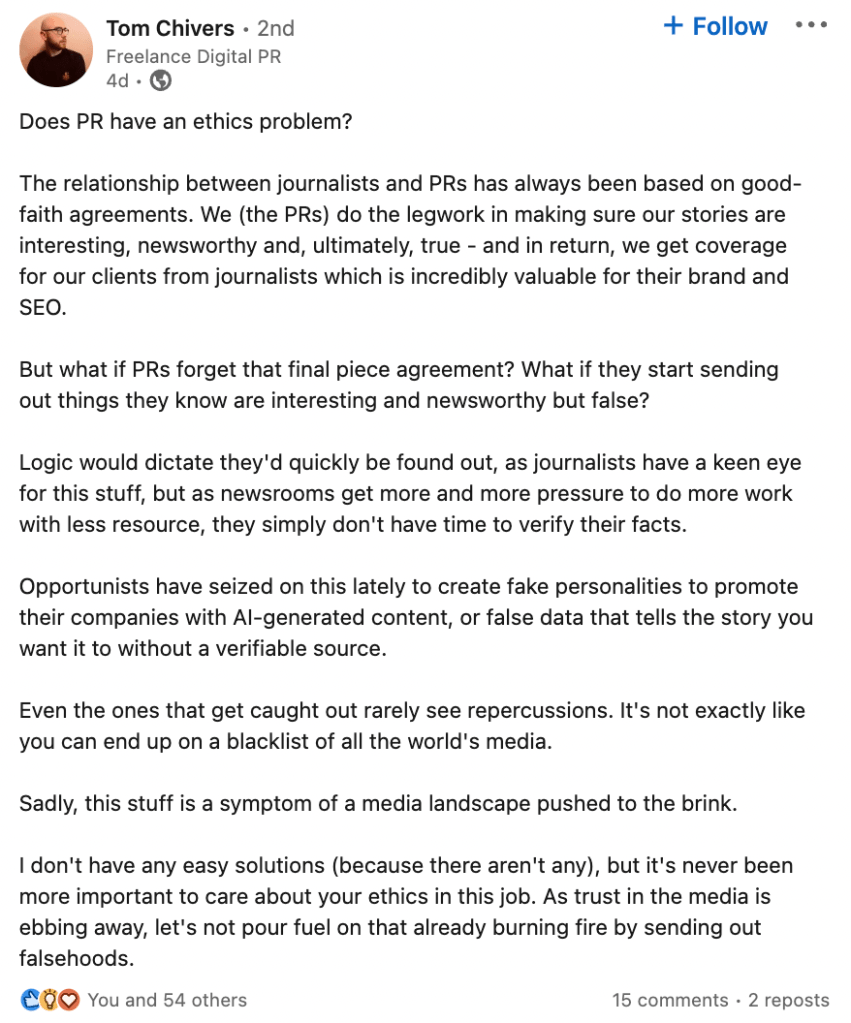
While yes, journalists should be checking and moderating the content we send them, the age-old PR agreement is that we pull together the story, they reward us with coverage.
This post from Tom on LinkedIn sums it up really nicely!
How We Can Sense-Check Our Stories
It’s well and good to say we need to do better. But how do we put that into action? Like Tom said, there aren’t any easy solutions, but small steps can lead to big changes. Some of my suggestions would include…
- Using reputable data collection sources, and utilising credible sample sizes so you don’t shoehorn your findings into the angle you want to push
- Thinking about who the end story might affect, how a headline might read and how it could be interpreted if that’s the only thing a person might read
- Always reference your sources
- Call out bad practices but in a constructive way. We don’t need to name names and instigate pile-ons on other agencies (if you’re wondering why, I suggest reading this blog I wrote), but at the same time, this is a great way to educate younger PRs
- Tailor your stories and your media lists, I guarantee you’ll get more worthwhile results like this anyway
- Check your campaigns and your final drafts with several people of different seniority before anything goes live – don’t put all the responsibility on one person to audit for every potential outcome.
Thank you as always for reading and for supporting me, and always happy to continue the conversation on my socials. Read my other blogs here whilst you wait for the next one.

 Jessica Pardoe | PR, Marketing and Communications Blogger | See All Posts By Jessica Pardoe